


Identification of non-health sectors with an impact on malaria transmission, and exploration of possibilities for collaboration in Burkina Faso
Overview
Why this project?
Malaria is still a public health challenge in Burkina Faso, one of 10 African countries facing a high malaria burden. Data from the statistical yearbook show a malaria incidence of 527 per 1000 country inhabitants and a mortality rate of 0.8%.
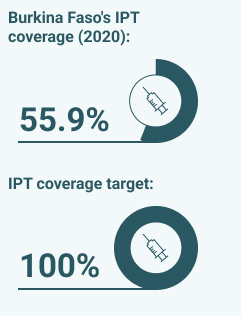
In 2020, the intermittent preventive treatment (IPT) coverage in Burkina Faso remained well below the target of 100% at only 55.9%. According to a 2017–2018 survey, only 58% of pregnant women received a minimum of three doses of IPT.
The same survey showed that long-lasting insecticidal net (LLIN) coverage in pregnant women was high at 97%, while 74% of households had at least one LLIN but only 58% slept under one at night.
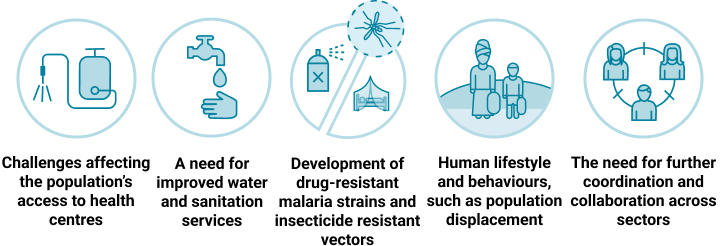
Factors contributing to the high incidence of malaria in Burkina Faso include:
Why the need for a multisectoral approach?
The main strategies for malaria control in Burkina Faso are:


Prevention
- Vector control
- Seasonal malaria chemoprevention
- Indoor residual spraying
- IPT
Case management
- Diagnosis and treatment
Programme management
- Coordination
- Communication
- Data management for decision-making
But the challenges are increasing...
With rising insecurity and internally displaced persons (IDPs), more individuals are becoming vulnerable to malaria. There is a need for improved access to prevention and management measures to address this situation.
Burkina Faso has committed to combat malaria through political will and adherence to global initiatives for malaria control, including the high burden to high impact (HBHI) approach.
The aims
The study has the following aims:
- Test and and deploy the Chinese 1,7 RDT approach in Burkina Faso. Other participating countries are Senegal, the United Republic of Tanzania and Zambia.
- To study the MSA approach in Burkina Faso.
Objectives
The objectives of the MSA component of the study are the following:
Identify non-health sectors that could provide support in malaria control.

Explore the possible benefits of including
non-health sectors, for all sectors involved.

Identify the impacts and benefits of the joint activity between health and non-health sectors.
The research sites
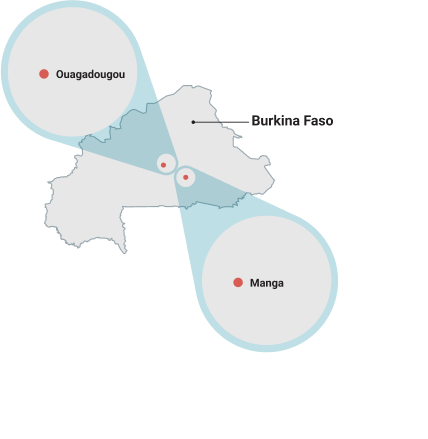
This study has been initiated in Ougadougou and Manga. It will later be extended to the other 13 regions in Burkina Faso.
Collaboration and funding
This project was part of a collaboration with the WHO Global Malaria Programme and the Chinese CDC and was financially supported by the UN Peace and Development Fund.
Research Sites
This study was initiated in Ougadougou and Manga and extended into Burkina Faso's 13 regions.

Research Components
Method
Given that the objectives of the research are mainly focused on proposals for solutions and support from other sectors, the methodological approach is qualitative.
- A qualitative cross-sectional study with a descriptive aim is carried out through a series of semi-structured individual interviews with the various institutional actors/sectors other than health.
- The interviews are based on a pre-established questionnaire completed in a qualitative way, in order to describe the obligations, concerns, activities, interactions and obligations of different sectors.
The process includes the following steps, further described below:
- Sampling
- Collection of data
- Quality assurance
- Ethical consideration
Sampling
A purposive sampling approach is used to select non-health sectors based on their contributions to malaria control, both material and non-material. Various criteria are considered to ensure a range of perspectives in identifying key informants for individual interviews. A total of 32 individual interviews are conducted with focal points from relevant institutions/sectors, as well as technical and financial partners.

Data collection
Two types of data collection are considered:
- Documentary review
- Qualitative study


Documentary review
Data collection on malaria control in Burkina Faso is informed by scientific reviews, reports from the National Malaria Control Program (NMCP), as well as meeting and workshop reports.
Qualitative study
Interviews are carried out with diverse stakeholders from non-health sectors using a predefined questionnaire.
Responses inform the study and clarify the perspectives of stakeholders regarding malaria control in Burkina Faso, as well as their interest in contributing to the elimination of the disease.
Quality assurance
The quality of the survey is ensured by interviewers with a background in social science and extensive experience in healthcare surveys. Daily monitoring is carried out to guarantee consistent and high-quality data, ensuring that all procedures are mastered.

Ethical consideration
To ensure ethical participation, the subsequent criteria is followed:
- Ethical approval is obtained from the National Health Research Ethics Committee (CERS).
- No informed consent is needed as study participants are selected by their respective institutions.
- All raw data remain confidential and stored in electronic form in the office of the principal investigator. This data will only be available to the research team.
- Data remain stored for the entire period of the study and for one year after termination of the study until the results are published.
- No one will be identified in the dissemination of the results or in the reports relating to the study.

Research Uptake
Objectives
Results from this research will be used to:
- encourage the implementation of a multisectoral approach for malaria control in Burkina Faso
- foster collaboration between health and non-health sectors for malaria control in the country.
Uptake activities
- At the country level, the process of engaging and working with stakeholders from non-health sectors should be used to implement adequate and relevant activities in other districts for malaria control. The results should be documented, published, and used to inform policies and decision-making regarding malaria control in the country.
- At the regional level, results can be shared and discussed during meetings or workshops with regional countries or partners, as well as international partners, in order to foster collaboration and south-south experience sharing for malaria control.
Publications and other resources
- Ministère de la santé, Annuaire statistique 2022
- Ministère de la santé, plan stratégie national de lutte contre le paludisme, PSN 2021-2025
- Sabatinelli G., Lamizana L , LE PALUDISME DANS LA VILLE DE OUAGADOUGOU (BURKINA FASO), Paris : ORSTOM, 1989, p. 187-193 (Colloques et Séminaires). ISBN 2-7099-0954-5 ISSN 0767-2896
- Institut National de la Statistique et de la Démographie Ouagadougou, Enquête sur les Indicateurs du Paludisme au Burkina Faso (EIPBF) 2014. Juillet 2015
- Institut National de la Statistique et de la Démographie Ouagadougou, Enquête sur les Indicateurs du Paludisme au Burkina Faso (EIPBF) 2017-2018. Décembre 2018 (MIS) 2017-2018)
Collaborating Partners
This project was part of a collaboration with the WHO Global Malaria Programme and the Chinese CDC and was financially supported by the UN Peace and Development Fund.
Additional collaborating partners include:
- United Nations Children's Fund
- United States Agency for International Development/President's Malaria Initiative
- Malaria Consortium
- United States Agency for International Development
- TDR, the UNICEF/UNDP/World Bank/WHO Special Programme for Research and Training in Tropical Diseases
Contact Details
Principal Investigator:
Dr. Moubassira Kagone
Centre de Recherche de Santé de Nouna Rue Namory Kéita, Nouna, Kossi, Burkina Faso
Email: kmoubache@yahoo.fr
Research Project Team:
- Dr. Moubassira KAGONE, Centre de Recherche en Santé de Nouna, principal investigator
- Dr. Gauthier TOUGRI, Permanent Secretariat for Malaria Elimination, Burkina Faso, Co-principal investigator
- Dr. Ambroise OUEDRAOGO, Permanent Secretariat for Malaria Elimination, Burkina Faso, Fieldwork coordinator
- Dr. Laurent MOYENGA, WHO Country Office, Burkina Faso, Technical support