

A multisectoral socially innovative approach to mosquito management
Mr Thouk Seng, the director of an elementary school in Kampong Cham, in central Cambodia, is part of a unique project. He and his students are growing guppy fish in large clay pots in his classroom. Not only are the fish being studied as part of a science class; they are also being deployed as eager predators of mosquito larvae, to control the transmission of dengue in the community.
In recent years, Kampong Cham, a city abounding with jars, pots, discarded tins, old tires and other water containers ideal for mosquitoes to breed in, has seen a steady rise in dengue, with about 3% of the population affected each year. Despite efforts to combat mosquitoes through insecticides and window screens in homes, they are not enough to compensate for the widespread use of these exposed water-filled containers.
TDR is supporting the School Dengue Project, led by Malaria Consortium in collaboration with ministries of education and health and other partners. This project, begun in June 2018, is investigating the benefits of two disease-specific interventions: 1) integrated vector management (IVM) reduction procedures; and 2) the communication for behavioural impact (COMBI) health education approach.
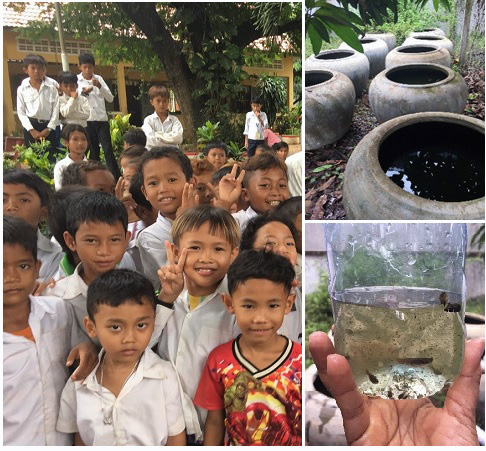
Community engagement is a critical component of the project. Teachers conduct classroom demonstrations and biology projects on mosquito behaviour, guppy rearing and setting up guppy banks. Parent–teacher discussion forums have also been conducted to raise community awareness of the project and for the development of culturally appropriate education materials for schools and families. Community knowledge, attitudes and practices (KAP) surveys related to dengue and other vector-borne diseases have been completed and are currently being analysed.
Fully operational guppy banks have been established in three community health centres, and more will be set up in 2019. Teachers and students will begin distributing the guppies to households in the community, and entomological surveys and household satisfaction surveys and interviews will be conducted. A costing study, mid-term reviews to assess progress, gaps and challenges, as well as an impact evaluation by an independent review panel are also planned.
The School Guppy Project is designed to be a sustainable, multisectoral, socially innovative, low-cost public health solution fostering community ownership, participation and empowerment. Stakeholders that have participated in the project include the National Malaria and Dengue Control Programme; Ministry of Health; Ministry of Education; Bournemouth University; the Global Health Asia Institute; the Institute of Tropical Medicine, Belgium; the Institut Pasteur, Cambodia; Malaria Consortium; the Cambodia Provincial Health Department; and the Cambodian National Center for Parasitology, Entomology and Malaria Control.
The School Guppy Project exemplifies TDR’s expertise in social science research to enable multisectoral, community-based solutions to improve health.
For more information, contact: Ms Makiko Kitamura, TDR Communications Officer, email: kitamuram@who.int.