

Chair of TDR’s Joint Coordinating Board Dr Modest Mulenga grew up in a humble environment. His father was a miner in Chingola, Zambia, and no one from his family had yet gone to university. But he had dreams that took him to one of the top universities in the world and led to a life of research and service.
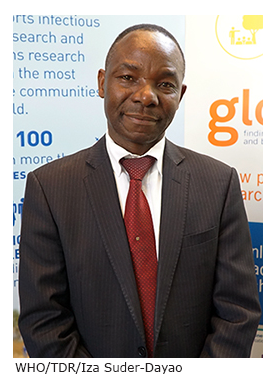 It was 1982 and Modest Mulenga had applied to the only medical school in Zambia at the time. There were about 20 000 applicants completing form five, and he ended up being one of only about 45 who were selected to go to the medical school.
“While growing up in a mining community, I was fascinated with the doctors in the nearby hospital who cared for those who worked in the mines and their families,” he explains. He knew early on that this was what he wanted to do in the future.
However, by the time he graduated and was practising in Solwezi district in the Northwest Province of Zambia, a small remote community, the economy was plunging, along with resources for controlling and managing diseases like malaria. The only first line
treatment then available was chloroquine, and the parasite’s resistance to this was increasing exponentially.
“Children were dying from malaria. Every day I came in to the hospital, children were arriving dead or were dying soon afterward. It was heartbreaking.” Modest’s own sister sadly died of the severe form of disease. That gave him the push to get further education for medical research.
He got a Master of Science degree in clinical tropical medicine with distinction at the London School of Hygiene and Tropical Medicine and went back to Zambia. Two years later he was promoted to head the Department of Clinical Sciences of the Tropical Diseases Research Centre (TDRC) at the Ndola Central Hospital, one of the centres set up by TDR at its inception, and started looking for an alternative to chloroquine.
We need teachers, housing and environment experts involved, and ideas from political, economical and business sectors to make the interventions easily accessible.
- Dr Modest Mulenga
The problems he found were much more diverse than he had anticipated. While a new treatment was critical, there were many other issues. The use of antimalarials was not adequately regulated, malaria control interventions were lacking and environmental management was not a priority.
During this same time, Modest was busy running clinical trials for a number of new antimalarials, and he received support from TDR to test new artemisinin-combination treatments that are now the mainstay of malaria care. TDR also provided him with a scholarship to go back to the London School of Hygiene and Tropical to complete a PhD in infectious and tropical diseases.
In London, Modest studied potential malaria therapies for children that could prevent the complications of severe anemia that was a major health risk for this disease. He was trying to find drugs that would keep blood levels healthy and avoid blood transfusions, which at that time put children at risk of contracting HIV.
Modest has continued to conduct research while heading TDRC as director. He has also brought his hard-earned experience back to TDR, this time as chair of the Joint Coordinating Board, TDR’s highest governing body.
In his current work with Professor Bill Moss of Johns Hopkins University, they have shown that school-aged children were not included in malaria educational and control programmes, housing conditions in rural areas allowed mosquitoes to breed and bite, and there was little training that helped people understand how to prevent the disease and accept the interventions. “I could see that other players needed to come on board,” he explains. “It has to be a multisectoral approach – we need teachers, housing and environment experts involved, and ideas from political, economical and business sectors to make the interventions easily accessible.”
He feels strongly that the use of research evidence needs to be expanded and intensified in order to better implement disease control or elimination programmes, and he wants to see more research capacity created in the countries most affected by infectious diseases such as malaria and HIV.
TDR Director John Reeder says, “Modest Mulenga knows first-hand the research needs of low-income countries. I have learned a lot from him and together we are focused on increasing the number of solutions developed from within the countries for their own problems.”
Modest remembers the start of his career well – with people at the end of the road, in very hard-to-reach places. He learned that without quality research conducted at the local level, the push for control and elimination of common diseases is impossible. This understanding drives his efforts both in Zambia, and internationally with TDR.
For more information, contact Kristen Kelleher.