

If his mother had her way, Dr Leonard Ortega, the newly appointed team leader of technical support and capacity building at the WHO’s Global Malaria Programme, would be Father Leonard Ortega, the Catholic priest.
“She wanted my older brother to be one, too,” he laughs, recalling his childhood in the Philippines, where he grew up in a family of eight children. “My father wanted me to be a lawyer, but I wasn’t very good in English. So I decided I would be an engineer – but then I wasn’t very good in math, either!” In the sciences, though, Leonard had excelled. “So finally I thought, I’ll become a doctor.” | 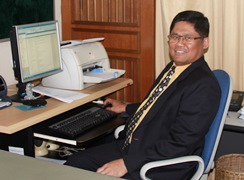 Leonard Ortega Provided by Leonard Ortega |
And that he did. After completing medical school in the capital, Manila, Leonard went to work in a remote rural health centre in Negros Occidental, and later a small public hospital in Aklan, his home province. There, he honed his clinical skills on cases of diarrhoea and tuberculosis, pneumonia and malnutrition, and other diseases of poverty endemic to the local population. “I wanted to help marginalized communities,” he says. Yet it wasn’t until a chance meeting with an expert in infectious diseases, a malaria researcher named Professor Nelia Salazar, that Leonard Ortega first considered a career in research.
The start of a research career with malaria
“It was really an accident,” he says. “After we met, she pushed me hard to go into research.” At Prof Salazar’s invitation, Leonard joined the Philippines’ Research Institute for Tropical Medicine (RITM), serving as a clinical monitor on a clinical trial of the malaria drug halofantrine. “That’s how I first learned about malaria – about the magnitude of the problem, and the challenges of controlling it.” This encouraged Leonard to move to the Philippines Malaria Control Program (MCP) in the province of Rizal, and then, through TDR’s capacity building initiative, Field Links for Intervention and Control Studies (FIELDLINCS), on to Ghana.
They had studies proving that insecticide-treated bednets are effective in Myanmar, but they were afraid that if they adopt a policy without the money to implement it, they would have a big problem.
- Leonard Ortega
“I read about FIELDLINCS in TDR News, so I applied and was accepted,” he says. In Ghana, Leonard served as the investigator on clinical malaria in children, a multicentre study in Africa supported by TDR. As part of the training in malaria research, he was attached to the large scale trial of insecticide-treated bednets carried out by Navrongo Health Research Center, under the mentorship of Dr Fred Binka, the director of the centre. A hands-on lesson in research design and methods, the experience allowed him to network with scientists around the world, and gave his career, he says, “a big boost.” Upon returning to the Philippines, Leonard was promoted, first to chief of research section, then division chief and acting director of the country’s malaria control service.
In 1998 Leonard applied for a fellowship with the newly-launched Roll Back Malaria Partnership (RBM) and sat for an interview with Dr Kamini Mendes, a veteran malariologist and senior adviser to the Director General in the RBM Cabinet Project. He didn’t get it. So impressed was Kamini with Leonard’s performance in the Philippines that she offered him, instead, a position as junior professional on the RBM staff. And at RBM, says Kamini, Leonard thrived. “He worked with tremendous initiative and contributed to the success of the RBM initiative through his experience in malaria control.”
A move to Myanmar where the need was great
After two years and a promotion at the RBM, Leonard made an unusual request: that he be moved to a malaria endemic country with a greater need for technical support. For months, Leonard had been facilitating the selection of a suitable candidate to head up the WHO Country Office in the capital, Yangon. “There were three applicants who were recommended by WHO but not accepted by the Government,” he recalls. “So, I decided, I should apply myself – and I was accepted.”
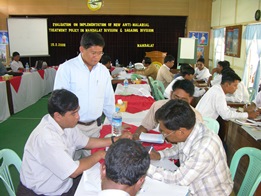 Leonard Ortega leading an evaluation Leonard Ortega leading an evaluationof anti-malarial treatment policy in Mandalay Provided by Leonard Ortega | With the move to Myanmar, Leonard confronted a challenge unlike any he had faced before. Plagued by political and economic instability, the military-run government was struggling to combat the largest malaria burden in the region. “It was very, very difficult,” he says. “When I became acting WHO Representative to Myanmar for one year, they were still transitioning to democracy.” |
Leonard explained that funding for these interventions wouldn’t be made available until the Government adopted the new tools. It took time to convince them, he says – a full year, in fact – “but eventually they agreed, and we were able to mobilize the money.”
“Leonard’s ability to lead, to set targets and work with partners to achieve our common goals was exceptional,” says Mya Sapal Ngon, a Myanmar national and former consultant to the WHO Country Office who credits her professional growth to Leonard mentorship. “He gave direct, constructive feedback, and he always pushed me to uphold high standards,” says Ngon, now a health programme manager with the U.S. Agency for International Development in Myanmar.
Leonard’s ability to lead, to set targets and work with partners to achieve our common goals was exceptional.
- Mya Sapal Ngon, health programme manager, U.S. Agency for International Development, Myanma
“Dr Ortega made an enormous contribution to malaria control in Myanmar, providing technical guidance, creating effective partnerships, and bringing much needed donor support to the country,” says Kamini. “He worked with impressive diplomacy and responsibility in a difficult political environment.” Later, in his capacity as malaria adviser to the WHO Regional Office for South-East Asia, Leonard helped countries across the Region move from malaria control to malaria elimination.
“He
gave his time generously and abundantly to colleagues in countries often
neglecting his own personal needs,” says Kamini. “His exemplary work
has earned WHO the respect of its member countries and made him a leader
in global public health.”
For more information, contact:
Makiko Kitamura
TDR Communications Officer
Telephone: +41 22 791 2926
email: kitamuram@who.int