

Building a national network to TB control
Political unrest in the 1970s Ethiopia changed the fate of Abraham Aseffa, a budding engineering undergraduate. The student movement that helped topple the old imperial order also resulted in closed universities. When they reopened, there was no room for re-admission, only some spaces at a new medical school. Luckily Aseffa embraced this unplanned career that eventually would lead to helping build one of Africa's most prestigious research institutes.
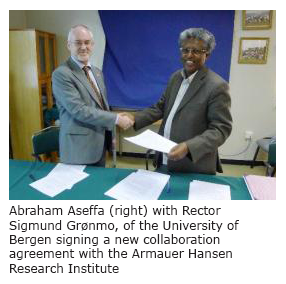 Aseffa was so taken with his new career in medicine that after graduation he decided to specialize in microbiology and immunology at the University of Leipzig, while East German professors built laboratory capacity back in Ethiopia. He returned to replace his German counterpart at the then Gondar College of Medical Sciences microbiology department.
Aseffa craved more research experience than was feasible there and after a three year work at the WHO Immunology Research and Training Centre in Lausanne, he applied to the Armauer Hansen Research Institute (AHRI) in the capital Addis Ababa.
A prestigious biomedical research laboratory that was founded in 1969 through an initiative of the Norwegian and Swedish organizations through the Ethiopian Ministry of Health, the Institute specialized in basic and applied research against mycobacterial and other diseases such as leishmaniasis, malaria and HIV. A former TDR Director, Tore Godal, was its second director, and the Institute produced over 600 papers in its first 40 years, including seminal works such as demonstrating drug-resistant leprosy which would lead to multidrug treatment regimens.
As ARHI's scientific director, Aseffa was prolific, says Professor Demissie Habte, president of the Ethiopian Academy of Sciences and chairman of the AHRI Scientific Advisory Board. “The research undertaken by Abraham will place him on the top list of outstanding researchers in the country and in the continent,” he says.
Saving a research beacon in the Horn of Africa
Helping AHRI has meant a large-scale transfer of knowledge from the North to researchers in Ethiopia. Aseffa's Institute is the main collaborator with universities in Ethiopia in producing PhD graduates, for instance. Professor Hazel Dockrell of the London School of Hygiene & Tropical Medicine, who worked with Aseffa in a leprosy research consortium, says training graduates is crucial. “I have witnessed his ability to scale up the research skills of AHRI scientists, to promote the training of scientists from all over Ethiopia,” she says. “He amazes me continually by the way he knows everything about all the students’ projects.”
It has also meant capacity building in other ways. TDR's grants have helped establish a national TB network and annual conference to optimize operational research methods for TB control in Ethiopia. There was a serious shortage of qualified clinical trial sites in East Africa, so TDR provided a grant for AHRI staff to train in good laboratory practice, good clinical practice (GCP) and ethical review systems. AHRI could now participate in international collaborations on high-profile clinical trials from a meningitis vaccine to a phase I clinical trial of a TB vaccine candidate with partners from Europe and Africa.
But importantly, the grants helped attract even more money. "One of AHRI's major achievements in the last 10 years is that we have been able to win grants from other funding agencies based on the hard work that TDR did in Ethiopia," says Aseffa.
AHRI has since mid-February 2016 been upgraded to a federal government institution under the ministry of health. A new Director General has been appointed by the Prime Minister, and Aseffa is now "Acting Deputy Director General for Research and Innovation".
For more information, please contact:
Makiko Kitamura
TDR Communications Officer
Telephone: +41 22 791 2926
email: kitamuram@who.int